Decoding Food Marketing: 'Natural', 'Organic', and What the Law Actually Says

Navigating the supermarket aisles can feel like an exercise in translation. Flashy packaging, bold claims, and green leaf icons suggest that what’s inside the box is good for you and your family.
Words like "Natural," "Organic," "Pure," and "Real" are plastered across front-of-pack labels to catch your eye—and justify a higher price tag. But what do these buzzwords actually mean under Australian law?
The truth is surprising: while some front-of-pack claims are strictly regulated by food standards, others are governed purely by consumer protection laws, leaving plenty of room for marketing spin. Here is what the law actually says about the claims on your family’s groceries.
1. "Organic": Not What You Might Expect
For many families, buying organic is a priority. However, Australia’s legal landscape surrounding "organic" claims has a major loophole that catches many shoppers off guard.
Domestic Sales vs. Exports: For a product to be exported as "organic," Australian law strictly requires official certification under government-managed standards. However, for products sold within Australia, organic certification is not mandatory by law.
The Voluntary Standard: Australia has a voluntary national standard for organic produce (AS 6000–2015), but businesses are not legally required to meet it just to use the word "organic" on domestic supermarket shelves.
How It’s Regulated: Instead of specific food standard regulations, organic claims fall under the Australian Consumer Law (ACL), enforced by the ACCC. Section 18 of the ACL states that businesses must not engage in conduct that is "misleading or deceptive".

The Takeaway for Families: Anyone can put "Organic" on a domestic food label, provided they can back up the claim if challenged by the ACCC. To ensure you’re getting true organic food, look for a logo from an accredited certifying body—such as ACO (Australian Certified Organic) or NASAA. If it has a certification logo or number, it has been independently audited.
2. "Natural": The Ultimate Marketing Loophole
If you assume "100% Natural" means a food is minimally processed or free from additives, think again.
The Code is Silent: Food Standards Australia New Zealand (FSANZ)—the body that sets the Food Standards Code—does not formally define the word "natural".
Process vs. Content: Unlike nutritional claims (like "High in Calcium" or "Low Fat"), which must meet strict compositional criteria under FSANZ Standard 1.2.7, "natural" is considered a process or non-nutrient claim.
The Consumer Law Safety Net: Like organic claims, "natural" claims are governed solely by general ACL provisions against misleading conduct. Courts generally evaluate the overall impression a label gives to an ordinary shopper.
For example, a product labeled "Natural Fruit Snacks" might contain highly refined fruit concentrates and natural sugars that have been heavily processed in a factory, but as long as the additives aren't synthetic, marketers can often legally defend the word "natural".
3. "No Added Sugar" vs. "Unsweetened" vs. "Sugar-Free"
Sugar claims are explicitly defined under FSANZ regulations (Standard 1.2.7), making them much more reliable than "natural". However, the exact wording matters:
Claim | What the Law Requires | What to Watch Out For |
No Added Sugar | The product contains no added hexose/pentose mono- or disaccharides, or foods derived from them (e.g., honey, malt extract, concentrated fruit juice). | The product can still be naturally very high in sugar (e.g., dried fruit, fruit juices, or dairy). |
Unsweetened | Meets "No Added Sugar" rules and contains no artificial, intense, or non-nutritive sweeteners (like stevia or erythritol). | Does not mean "low sugar"—natural sugars are still present. |
Sugar-Free | Must contain no more than 0.2g of sugar per 100g (or 100mL) of the final food. | May contain artificial sweeteners or sugar alcohols to maintain sweetness. |
4. "Made from Real Fruit" or "Made with Whole Grains"
This is a classic front-of-pack technique known as a highlight claim.
Under FSANZ Standard 1.2.4, if a brand highlights an ingredient on the front of the pack—either in words (e.g., "Contains real strawberry") or with pictures (e.g., photos of fresh strawberries)—they are legally required to declare the percentage of that ingredient in the ingredient list (known as Percentage Labelling).
The Catch: A box of muesli bars might boldly advertise "Made with Real Strawberries," but checking the back might reveal: Strawberry preparation (1.5%).
The Reality: The claim is legally compliant because the percentage is stated on the back, even if the front of the pack creates a much grander impression.
Smart Shopping: A Quick Cheat Sheet for Families
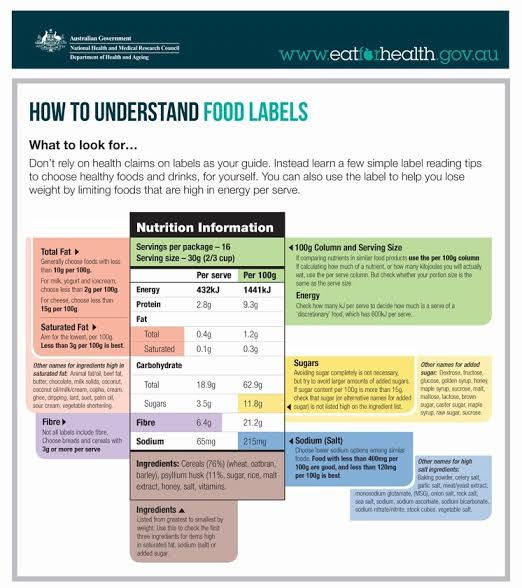
Flip the Pack Immediately: Ignore the front-of-pack marketing. The truth is always on the back: in the Ingredients List (ordered from largest to smallest quantity by weight) and the Nutrition Information Panel (NIP).
Check the Percentage: Look for the percentage next to key ingredients you care about (e.g., Fruit (2%) vs Fruit (40%)).
Look for Certification Marks: For organic claims, don't rely on green paint or leafy graphics; look for official certifier logos.
Distinguish Natural Sugars from Total Sugars: Check the NIP for grams of sugar per 100g to compare products fairly, regardless of whether the front says "No Added Sugar."
Understanding Australian food regulations allows you to spot marketing tactics instantly, helping you make informed, healthy choices for your family.


Comments